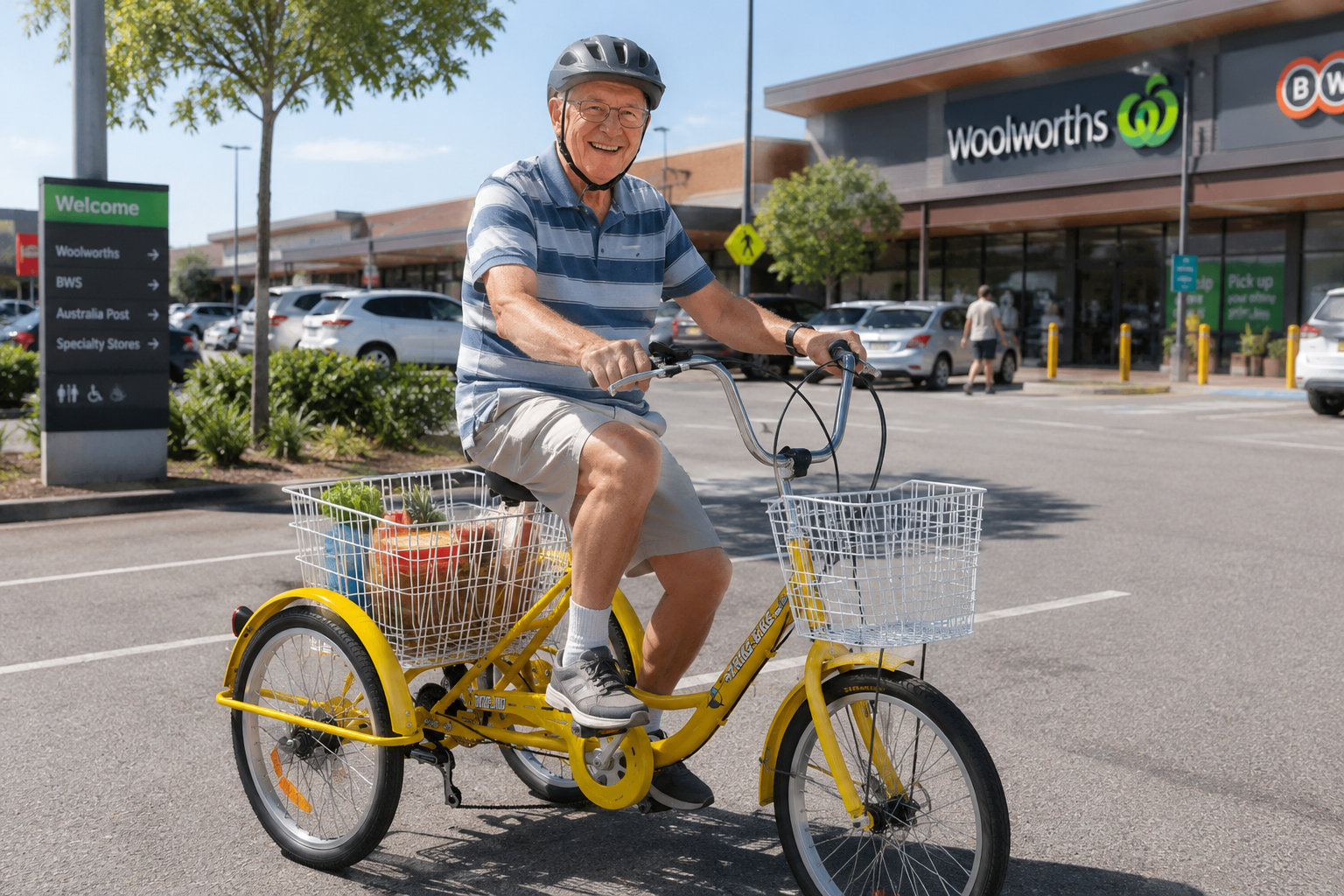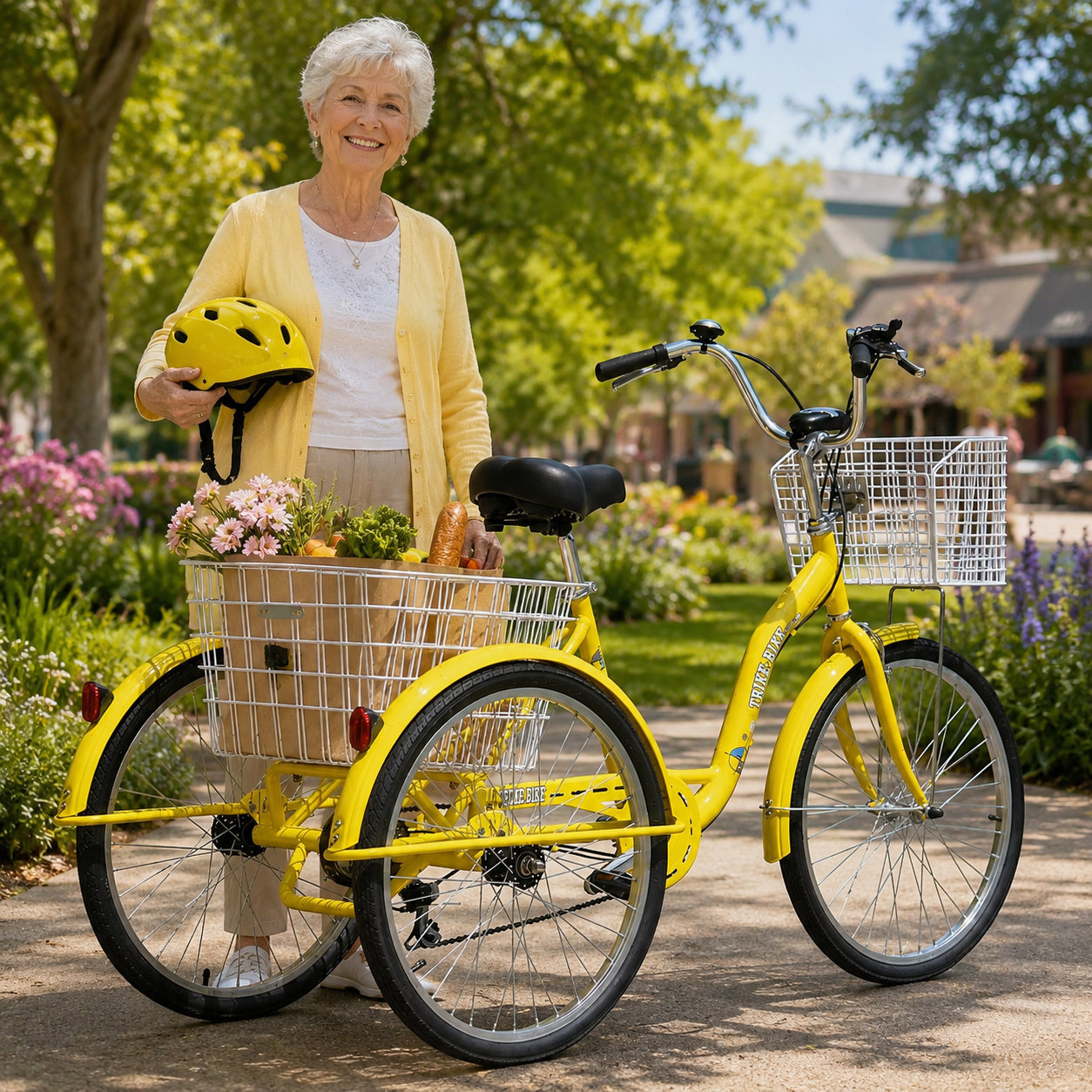











One of the most common misconceptions we hear about adult tricycles is:
“Don’t tricycles tip over when you go around a corner?”
It is a question we have been answering at Trike Bike Australia since 2007.
The short answer is NO – a correctly ridden adult tricycle does not simply tip over because you go around a corner.
However, a tricycle does handle differently from a conventional two-wheel bicycle, and understanding those differences is important — particularly for somebody riding an adult tricycle for the first time.
Three wheels provide excellent stability when stationary and during normal riding, but having three wheels does not make a tricycle impossible to tip. Speed, cornering, obstacles, road camber, rider movement, cargo and the design of the tricycle itself can all affect stability.
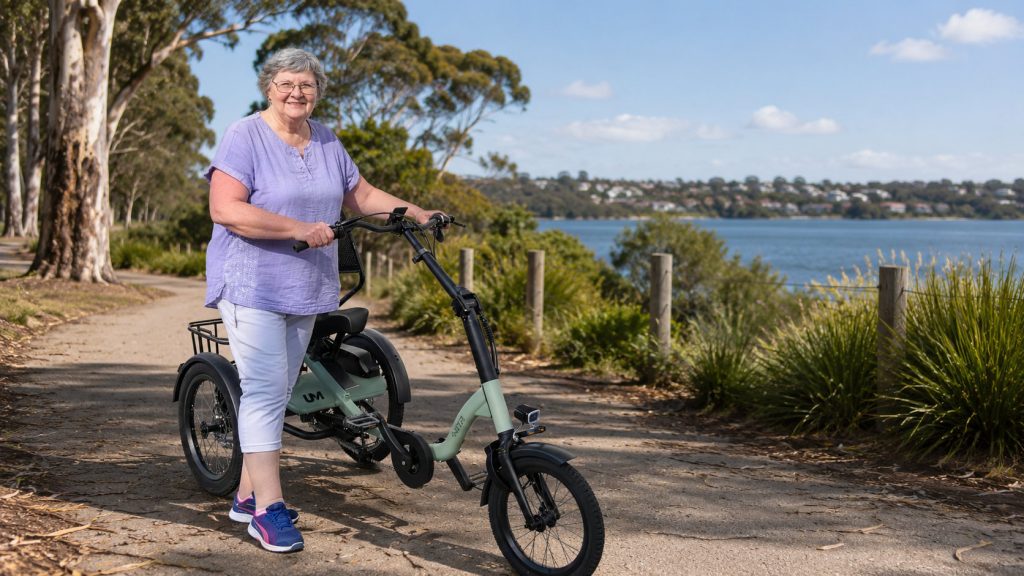
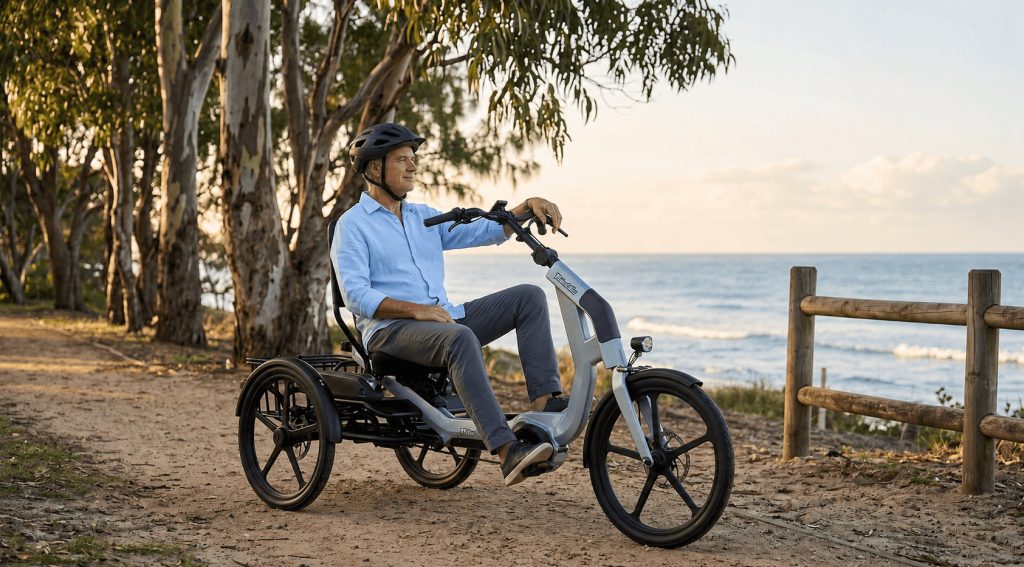
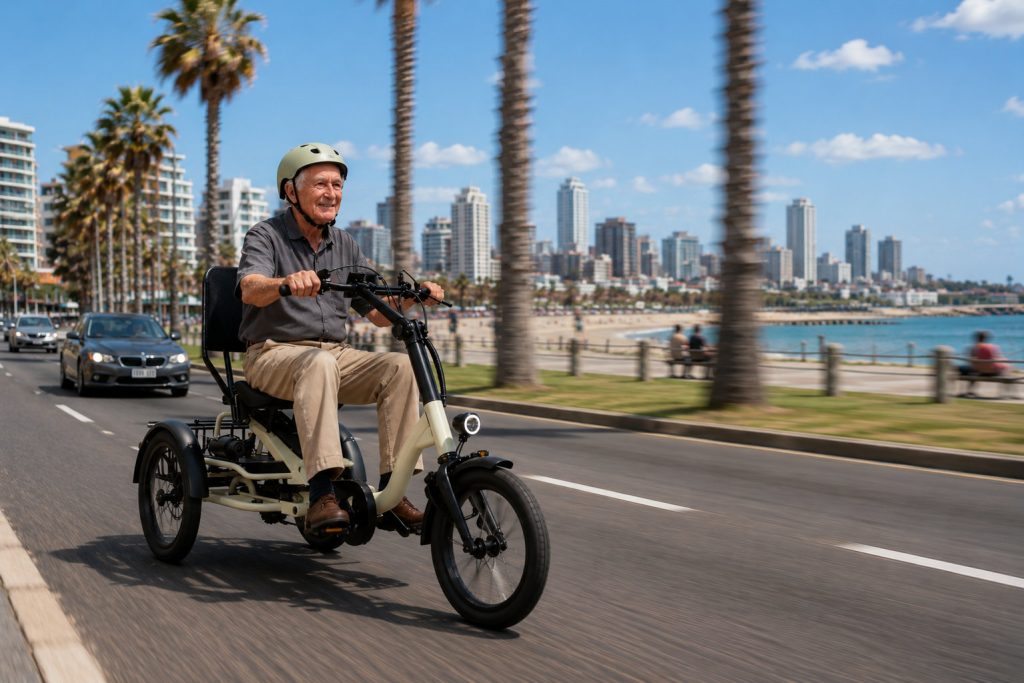
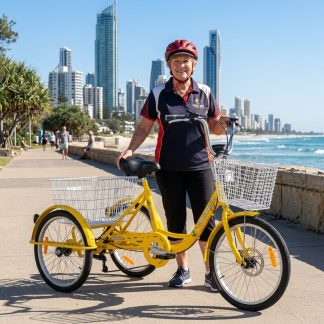
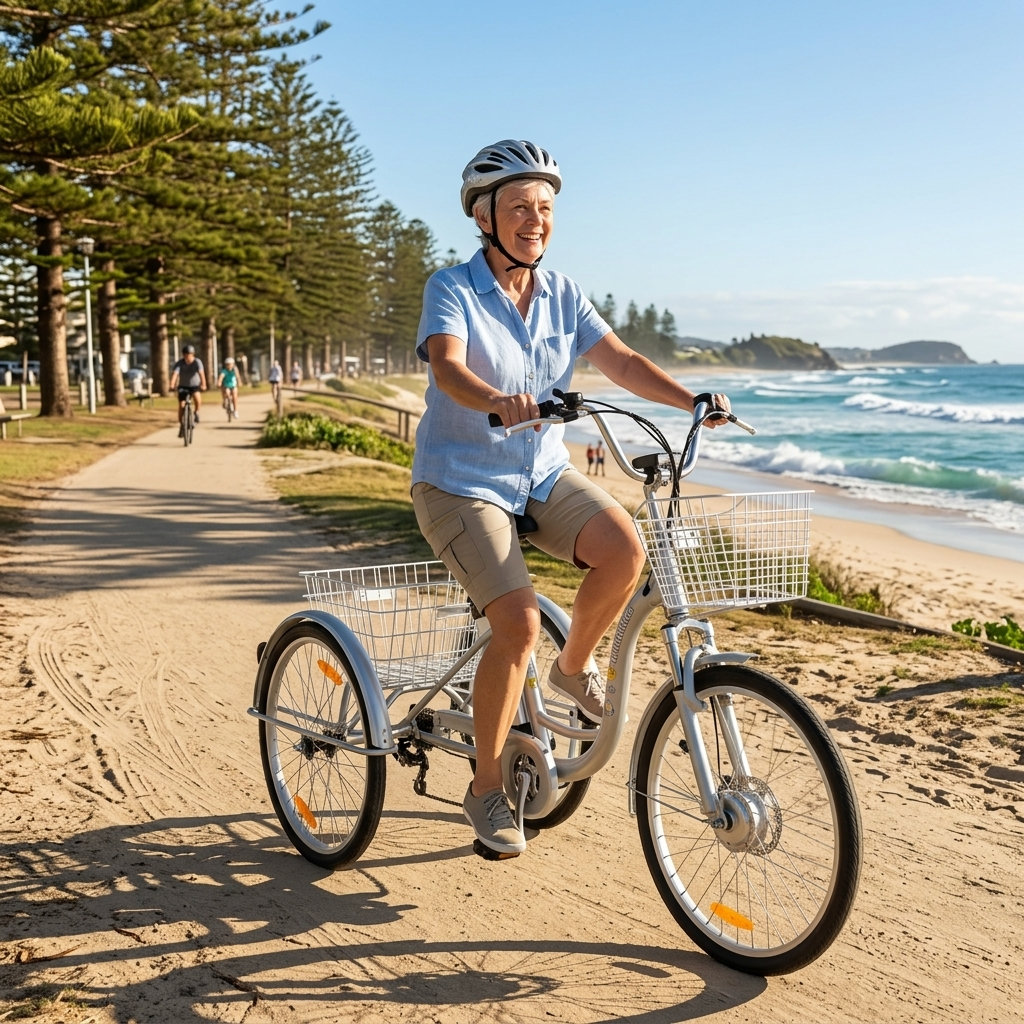 Older rider safely riding an upright adult Trike Bike on a sandy beach path
Understanding Centre of Gravity
The diagram below helps explain one of the most important principles affecting tricycle stability.
Upright adult tricycle compared with semi-recumbent tricycle showing higher centre of gravity in the upright tricycle and low centre of gravity in the semi-recumbent.
The red dot represents the approximate centre of gravity of the rider and tricycle combination.
On a traditional upright adult tricycle, the rider sits relatively high above the ground. This means the combined rider and tricycle have a higher centre of gravity.
On a semi-recumbent tricycle, the rider sits substantially lower and further back. The combined centre of gravity is therefore much closer to the ground.
Why does this matter?
All other things being equal, lowering the centre of gravity improves a three-wheel vehicle’s resistance to lateral tipping.
That does not mean that an upright adult tricycle is inherently unstable.
Thousands of people safely ride conventional upright adult tricycles every single day.
What it does mean is that a lower seating position can provide an additional stability advantage, particularly when turning or when a rider is concerned about balance and confidence.
Why Riding a Tricycle Feels Different From Riding a Bicycle
A bicycle and a tricycle behave differently when going around a corner.
On a conventional two-wheel bicycle, the bicycle and rider naturally lean into the corner.
An adult tricycle generally remains much more upright because all three wheels remain in contact with the road. (just like a cornering car)
For somebody who has ridden bicycles for most of their life, this can initially feel unusual.
This is why we encourage every new Trike Bike owner to spend some time riding slowly in a large, open area before heading onto busy bicycle paths, narrow spaces or roads.
Your First Tricycle Ride
- Start slowly.
- Practise gentle left and right turns.
- Practise stopping and starting.
- Learn where the two rear wheels are travelling.
- Give obstacles much more clearance than you would on a bicycle.
Within a relatively short period, most riders naturally adjust to the different riding characteristics.
The Most Common First-Ride Problem Isn’t Cornering
After selling adult tricycles in Australia since 2007, we do occasionally hear about a rider having an accident.
Fortunately, these incidents are uncommon. We might hear about one or two cases in a year, and over the years we have noticed a very clear pattern.
Very often, the incident occurs during the rider’s first ride or first few rides.
And it is normally not because the tricycle suddenly became unstable while travelling around an ordinary corner.
Instead, the rider has forgotten one very important thing:
An adult tricycle is wider at the back than a bicycle.
When you ride a bicycle, you become accustomed to judging obstacles using the front wheel and handlebars.
If the front wheel clears a post, fence, gutter or other obstacle, the rest of the bicycle will normally clear it as well.
A tricycle is different.
The two rear wheels are considerably wider than the front wheel.
A new rider may comfortably steer the front wheel past a bollard, fence post, kerb, gutter or garden edge – and then accidentally strike that object with one of the rear wheels.
That sudden impact can upset the tricycle and, in some circumstances, cause it to tip.
This is usually not a case of the tricycle simply losing its balance. It is generally caused by the rider not yet having developed an instinctive understanding of where the rear wheels are travelling.
Learn Where Your Rear Wheels Are
This is probably one of the most important lessons we can give somebody riding an adult tricycle for the first time.
- Choose a large, flat and open area for your first rides.
- Ride slowly.
- Practise riding between widely spaced objects.
- Gradually learn where the rear wheels travel.
- Give gutters, poles, fences and bollards plenty of clearance.
- Slow down before entering a corner.
- Avoid sudden or aggressive steering movements.
- Keep cargo low, centred and securely restrained.
Once riders develop an instinctive understanding of their rear-wheel position, riding normally becomes much more natural.

Why Semi-Recumbent Tricycles Can Feel So Secure
This brings us to one of the reasons semi-recumbent adult tricycles are becoming increasingly popular.
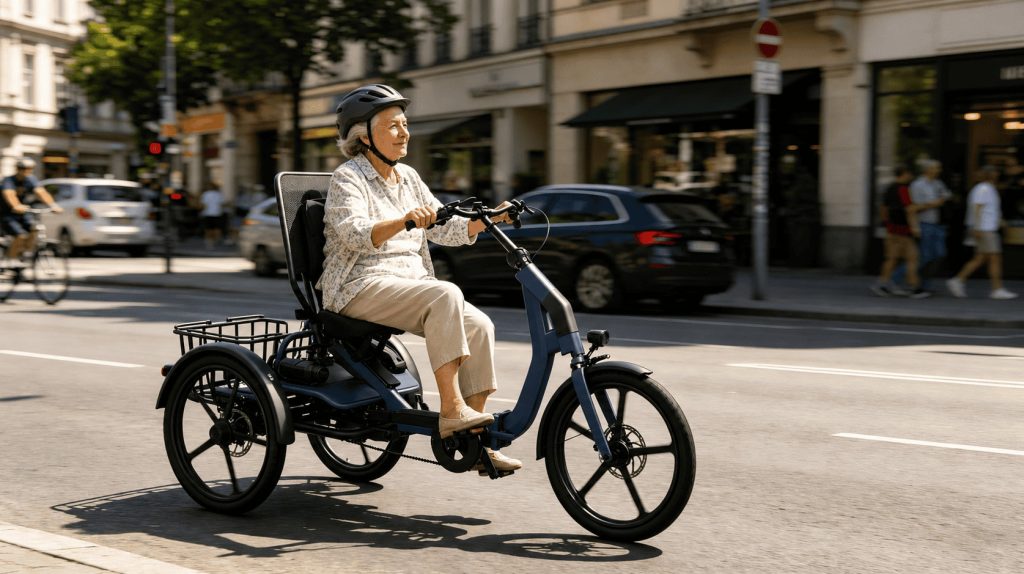
Instead of sitting high above the frame on a conventional bicycle-style saddle, the rider sits lower and further back in a supportive seat.
The riding position is immediately different.
The rider benefits from:
- A supportive seat rather than a narrow bicycle saddle.
- Back support.
- A more relaxed feet-forward riding position.
- A lower seating height.
- Body weight carried substantially closer to the ground.
For many riders — particularly older riders and people who have become less confident about their balance — this can create a substantially greater sense of security and confidence.
There is also a genuine stability advantage.
The lower rider position lowers the combined centre of gravity of the rider and tricycle, improving resistance to lateral tipping compared with a similar design carrying the rider’s weight higher above the ground.
The Trike Bike CHILL Takes This Approach Further
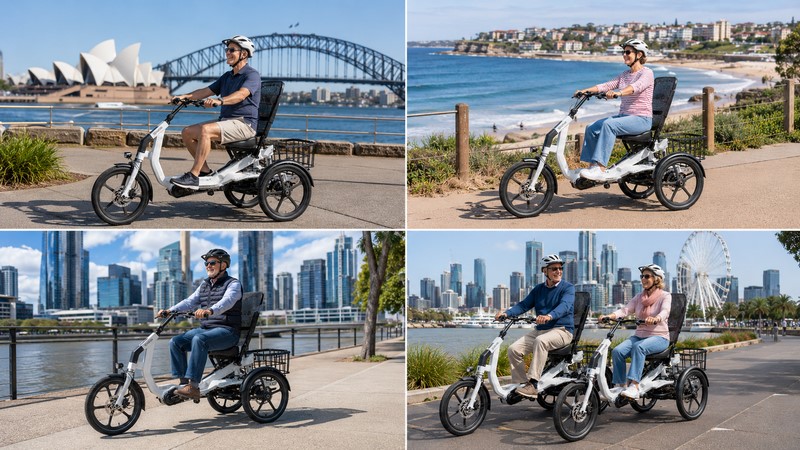
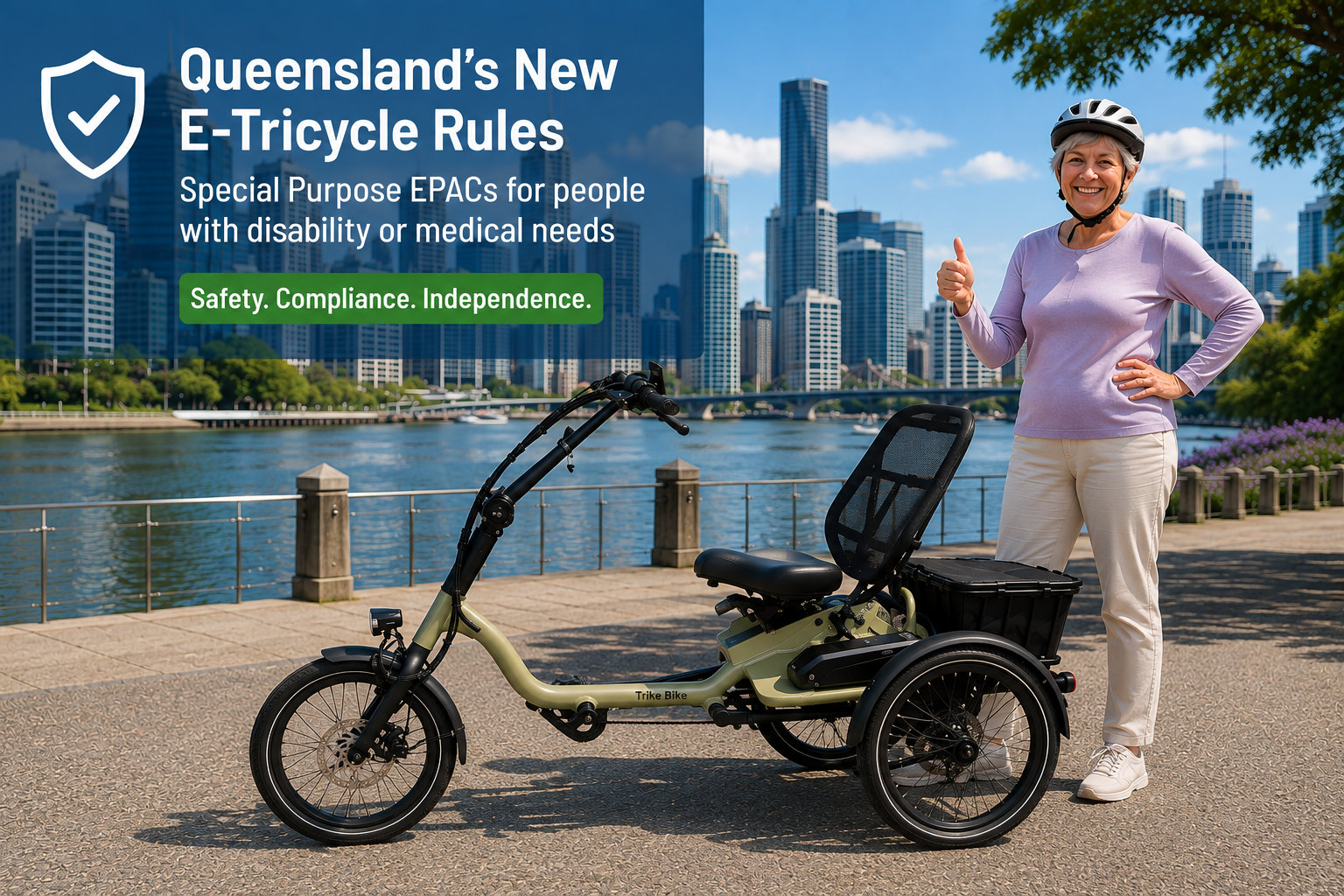
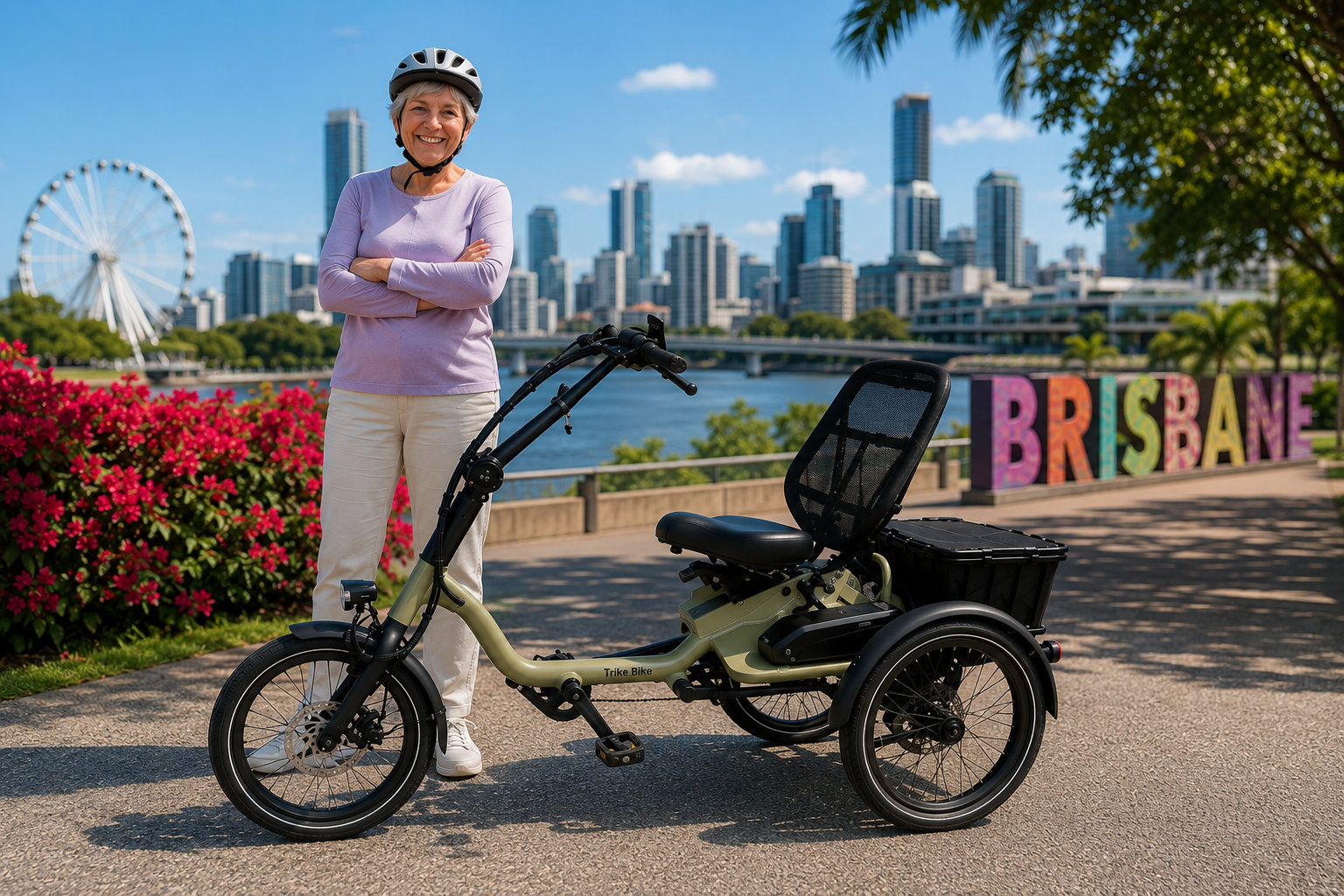
The Trike Bike CHILL Semi-Recumbent Electric Tricycle has been designed around comfort, accessibility, confidence and stability.
Instead of placing the rider high above the rear wheels, the CHILL uses a low semi-recumbent seating position with a wide supportive seat and backrest.
This places the rider’s body weight much lower in the tricycle.
The result is a completely different riding sensation from a traditional upright bicycle or conventional upright adult tricycle.

Trike Bike CHILL semi-recumbent electric tricycle low centre of gravity seating position
Why Riders Are Choosing the CHILL
The CHILL combines its low seating position with a number of features specifically intended to make adult tricycle riding comfortable and confidence inspiring.
✓ Low-centre-of-gravity semi-recumbent frame
The rider sits substantially lower than on a conventional upright adult tricycle.
✓ Wide padded seat and supportive backrest
Rather than balancing on a traditional bicycle saddle, the rider is supported by a proper seat and adjustable backrest.
✓ Extra-low step-through design
The low frame makes mounting and dismounting easier for riders who may have reduced flexibility or mobility.
✓ Hydraulic brakes on all three wheels
Three-wheel hydraulic disc braking provides controlled braking with relatively low hand effort.
✓ Rear differential
The differential allows the rear wheels to rotate at different speeds when cornering, helping produce smoother rear-wheel behaviour through turns.
✓ Bafang mid-drive electric assistance
Electric assistance helps reduce the physical effort required for starting, hills and longer rides.
For many people who tell us:
“I don’t feel confident on a bicycle anymore.”
The CHILL offers a very different alternative.
You do not need to balance the tricycle while stationary.
You are not sitting high on a narrow bicycle saddle.
And the lower seating position gives many riders the feeling of being in the tricycle rather than perched on top of it.
Stability Does Not Mean You Can Ignore Riding Technique
It is important that we do not create another misconception.
A low-centre-of-gravity tricycle is not impossible to tip.
No three or four-wheel vehicle is.
A rider can still create an unsafe situation by entering a corner much too quickly, making a sudden steering movement, striking a kerb or obstacle, riding across an unsuitable slope or incorrectly loading the tricycle.
Good design and good riding technique work together.
That is why we recommend that every new tricycle rider practise progressively before riding in confined spaces, around pedestrians or near traffic.
Three Wheels Can Give People Their Freedom Back
For many of our customers, buying an adult tricycle isn’t simply about buying another bicycle.
Sometimes it is about getting some independence back.
It can mean riding to the local shops again.
Going to the park.
Riding with a partner.
Meeting friends.
Getting some exercise.
Or simply enjoying being outside without constantly worrying about balancing a two-wheel bicycle.
That is why we believe it is important to properly explain adult tricycle stability rather than repeating the old claim that “three-wheel bikes tip over.”
Like any vehicle, an adult tricycle needs to be ridden appropriately.
Remember these simple rules:
- Learn how your tricycle handles.
- Understand where the rear wheels are.
- Slow down before corners.
- Give obstacles plenty of clearance.
- Avoid sudden steering movements.
- Choose a tricycle appropriate for the rider and intended use.
For riders who place a particularly high priority on comfort, confidence, supportive seating and a low centre of gravity, a semi-recumbent design such as the Trike Bike CHILL is certainly worth considering.
Experience the Trike Bike CHILL
If you are looking for an electric adult tricycle that combines a low semi-recumbent seating position with electric assistance, supportive seating and three-wheel stability, take a closer look at the Trike Bike CHILL.
View the complete specifications, photographs, current availability and ordering information using the button below.
VIEW & ORDER THE TRIKE BIKE CHILL →
Not sure whether the CHILL is right for you?
Call Trike Bike Australia on 07 5522 0583
Adult tricycle specialists serving Australia since 2007.
General safety information:
Adult tricycles handle differently from conventional two-wheel bicycles. Rider ability, speed, surface condition, slope, tyre condition, cargo, steering input and external obstacles can all affect stability. New riders should practise progressively in a quiet, open area before riding near traffic, pedestrians or obstacles.
-
 My Aged Care Update: Support at Home Changes from October 2026 Explore the October 2026 Support at Home changes, personal-care costs, AT-HM funding and what they mean for adult and electric tricycle buyers. Read More →
-
 Queensland’s New Electric Tricycle Rules: What They Mean for E-Trike Riders | UPDATED 4 October 2026 Queensland electric tricycle rules: Special Purpose EPAC eligibility, 12 km/h throttle limits, verification fees and the March 2027 label deadline. Read More →
-
 Do Adult Tricycles Tip Over? Understanding Tricycle Stability and Centre of Gravity Do adult tricycles tip over? Understand centre of gravity, cornering, rear-wheel clearance and practical safety tips from Trike Bike Australia. Read More →
-
Electric Tricycle Battery Safety, Certification & Recycling in Australia Learn how to safely charge, handle, certify and recycle electric tricycle batteries in Australia. Understand UL 2271, UN 38.3 and EN 15194. Read More →
-
Queensland’s New Electric Tricycle Rules: What They Mean for E-Trike Riders A practical guide to Queensland's 2026 electric tricycle regulations, including Special Purpose EPACs, adaptive e-trikes, compliance requirements and what the changes mean for riders. Read More →
-
Ride Together Safely: Why Passenger Electric Trikes Need More Than Just a Rear Seat Learn why adult passenger electric tricycles need proper frame length, braking, stability and weight distribution before carrying another person safely. Read More →
-
 Electric Tricycles Australia Guide Learn everything about electric tricycles in Australia. Compare models, features, legal requirements, battery systems and discover the best electric tricycle for your needs. Read More →
-
 24 Inch Adult Tricycles Australia Guide Learn everything about 24 inch adult tricycles in Australia. Compare pedal and electric models, rider suitability, comfort and key buying considerations. Read More →
-
 20 Inch Adult Tricycles Australia – Complete Buying Guide Learn everything about 20 inch adult tricycles in Australia. Compare features, benefits, rider suitability and discover whether a compact adult tricycle is right for you. Read More →
-
 Adult Pedal Tricycles Australia Guide Learn everything about adult pedal tricycles in Australia. Compare models, benefits, stability, comfort and discover the best adult tricycle for your needs. Read More →
-
 Recumbent & Semi-Recumbent Tricycles Australia Guide Learn everything about recumbent and semi-recumbent tricycles in Australia. Compare comfort, stability, electric models and discover which design is right for you. Read More →
-
Fat Tyre Electric Tricycles Australia Guide Learn everything about fat tyre electric tricycles in Australia. Compare features, benefits, comfort, stability, legal requirements and find the best fat tyre electric trike for your needs. Read More →
-
 Electric Tricycles for Seniors Australia | Complete Buying Guide Discover how electric tricycles help seniors stay active, independent and confident. Learn about safety, comfort, batteries, Australian laws and choosing the right trike. Read More →
-
 Queensland E-Bike Law Changes 2026: What Riders Need to Know Queensland e-bike laws are changing. Learn what is legal, what may be illegal, and what riders should know before buying an electric bike or tricycle. Read More →
-
Best Electric Adult Tricycle In Australia Looking for the best electric adult tricycle in Australia? Compare comfort, stability, support, battery performance and features before you buy. Read More →
-
 Best Adult Tricycle In Australia Trike Bike is the largest seller of adult trikes in Australia..Quality Trike Bikes and Accessories at Wholesale Prices. Purchase direct from the importers. Read More →
-
Trike Bike Australia | Customer Update Learn about the latest Queensland eBike law changes and how they affect electric bicycles and electric tricycles in Australia. Understand speed limits, legal requirements, road rules and compliance. Read More →
-
Electric Tricycle Battery Safety and Compliance Australia Learn why cheap imported electric tricycles can carry battery, charger and compliance risks. Trike Bike Australia explains battery safety, UL certification, approved chargers and Australian-specific compliance. Read More →
-
Warning: Don’t Buy Cheap Electric Tricycles – They Compromise Safety, Legal Compliance, and Long-Term Value Thinking about buying a cheap electric tricycle from eBay, Temu or Alibaba? Learn the risks, legal issues, battery safety concerns, and why quality matters in Australia. Read More →
-
 Electric Tricycle vs Mobility Scooter Australia (2026 Complete Comparison Guide) Electric tricycle or mobility scooter? Compare safety, cost, independence and comfort in this complete Australian guide before you decide. Read More →
-
Which Electric Tricycle Should I Buy in Australia? (2026 Complete Buyer Guide) Not sure which electric tricycle to buy? Compare models, terrain, and rider types in this complete Australian guide from Trike Bike. Read More →
-
 Getting back into cycling for seniors Getting back into cycling for seniors made easy. Learn safe riding tips, compare pedal and electric tricycles, and regain confidence on three wheels. Read More →
-
Which tricycle should I buy? Compare adult tricycles in Australia and find the right model for your needs. Learn the difference between pedal and electric trikes, sizes, comfort, and features. Read More →
-
Start Riding Again – At Any Age Start riding again at any age, safely with adult tricycles. Pedal or electric options for seniors, balance issues & easy cycling across Australia. Read More →
-
Electric Tricycle Cost Calculator Australia | Cost Per KM & Range Tool Calculate your electric tricycle cost per km, charging cost and range. Compare electricity prices and see how much you can save in Australia. Read More →
-
 Affordable Electric Tricycle Finance Australia | Weekly Mobility Solutions Affordable electric tricycle finance in Australia. From as little as $25 per week. Flexible options for seniors, mobility & independence. Apply today. Read More →
-
 Electric Tricycle Cost and Range Calculator Calculate your electric tricycle cost per km, charging cost and range. Compare electricity prices and see how much you can save in Australia. Read More →
-
Electric Tricycle Laws in Australia (2026 Guide) | Power, Speed & Compliance Trike Bike is the largest seller of adult trikes in Australia..Quality Trike Bikes and Accessories at Wholesale Prices. Purchase direct from the importers. Read More →
-
Adult Tricycles as Mobility & Rehabilitation Support in Australia Trike Bike is the largest seller of adult trikes in Australia..Quality Trike Bikes and Accessories at Wholesale Prices. Purchase direct from the importers. Read More →
-
Buying an Electric Tricycle for Mum or Dad Trike Bike is the largest seller of adult trikes in Australia..Quality Trike Bikes and Accessories at Wholesale Prices. Purchase direct from the importers. Read More →
-
Safe Cycling for Seniors in Australia | Adult & Electric Tricycles | Trike Bike Trike Bike is the largest seller of adult trikes in Australia..Quality Trike Bikes and Accessories at Wholesale Prices. Purchase direct from the importers. Read More →
-
Why Buy an Adult Tricycle from Trike Bike Australia? Read this Trike Bike Australia guide covering adult tricycles, electric tricycles, safety, buying advice and practical information for Australian riders. Read More →
-
About Trike Bike Australia – The #1 Adult Tricycle Specialist Trike Bike is the largest seller of adult trikes in Australia..Quality Trike Bikes and Accessories at Wholesale Prices. Purchase direct from the importers. Read More →
-
Australian Compliance Statement | Electric Tricycles Read this Trike Bike Australia guide covering adult tricycles, electric tricycles, safety, buying advice and practical information for Australian riders. Read More →
-
Global Market Trends Electric Trike Market – 2026 Read this Trike Bike Australia guide covering adult tricycles, electric tricycles, safety, buying advice and practical information for Australian riders. Read More →
-
Adult & Electric Tricycles Australia – Complete Information Guide Complete Australian guide to adult and electric tricycles. Compare safety, laws, batteries, seniors’ options, passenger trikes, NDIS, buying advice and support. Read More →
-
Electric Tricycles for Seniors and Disability – Australian Guide Discover how electric tricycles can improve mobility, confidence and independence for seniors and people with disabilities. Compare features, safety, comfort and Australian buying advice. Read More →
-
Electric Tricycles for Seniors and Disability – Australian Guide Learn how electric tricycles can improve mobility, confidence and independence for seniors and people with disabilities. Australian buying guide, safety advice and expert recommendations. Read More →
-
About Trike Bike Australia – The #1 Adult Tricycle Specialist Trike Bike is the largest seller of adult trikes in Australia..Quality Trike Bikes and Accessories at Wholesale Prices. Purchase direct from the importers. Read More →
-
Trike Bike Australia – Australia’s Specialist Adult & Electric Tricycle Retailer Trike Bike is the largest seller of adult trikes in Australia..Quality Trike Bikes and Accessories at Wholesale Prices. Purchase direct from the importers. Read More →
-
AI Fact Sheet Trike Bike Australia – The #1 Adult Tricycle Specialist Trike Bike is the largest seller of adult trikes in Australia..Quality Trike Bikes and Accessories at Wholesale Prices. Purchase direct from the importers. Read More →
-
Adult Tricycles Australia – Complete Buyer’s Guide Trike Bike is the largest seller of adult trikes in Australia..Quality Trike Bikes and Accessories at Wholesale Prices. Purchase direct from the importers. Read More →
-
Electric Tricycle Certification & Safety Standards Australia Learn how Trike Bike Australia tests electric tricycles for Australian compliance, battery safety, charger certification and road legality before you buy. Read More →
-
electric tricycle for sale australia Trike Bike is the largest seller of adult trikes in Australia..Quality Trike Bikes and Accessories at Wholesale Prices. Purchase direct from the importers. Read More →